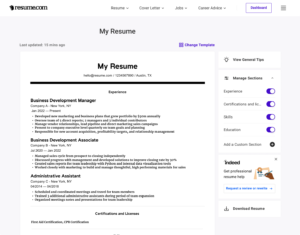
The Resume – What is it ?
Now a day, do a search on the web on the word “Resume” and you can come up with a number of resume services and mostly types. The two most common that appear are the chronological resume and the functional resume. Another popular form of writing one’s career experience is utilizing the Curriculum Vitae (CV). The CV, used mostly in foreign countries or by educators and scientist, is a detailed, lengthy and structured listing of education, publications, projects, awards and work history. A Curriculum Vita is mostly considered for mid-career (professional) candidates and may be lengthy. In this section we will focus on the chronological and functional resume.
1. What Is a Resume? A Resume is your marketing tool, one that identifies your objectives, experience, and accomplishments. It provides the reader with information that can demonstrate where your career is heading, or what your future goals are. It is not about your past jobs or positions, it is about how you accomplished your duties at those jobs, your skills, how successful you were, about your performance, and where you are heading with your career; in essence it is about YOU.
If you have ever written or read a Resume, you will note that most people describe their past job responsibilities with “responsibilities included…” You can improve your resume ten-fold by avoiding these type of standardized phrases. Focus, instead, on your job accomplishments.
As an introduction, begin your resume with your Career / Job Objective. Identify your job target (objective), but remember to be as concise as possible; this should be accomplished with one brief sentence.
If you are new in the job market, you may have limited “job experience.” Use volunteer work, part-time jobs, seasonal jobs or educational experience. If you have a long career history, how far should you go? As far back as necessary; keep in mind that you should try to keep your resume as short as possible. You can avoid high school information, hobbies, religious or ethnic affiliations, unless it is directly relevant to your job objective. Concentrate on what you can do for the employer; what you, will bring to the table; what benefits they will get should they hire you, etc. Remember there are more appropriate words you can use in Job Titles, and key words to describe your job function.
Keep your resume simple and clean. The only question left is which resume format should I use, chronological, functional, or combination of the two.
Chronological
The chronological resume if perhaps the most commonly used today, in substance and format. The chronological resume is organized by job titles with the most recent position listed first.
Employers tend to prefer the chronological resume because the format lists prior positions beginning with the most current. Employers perceive this resume style as fact-based and easily skimmed.
The Chronological resume is best for job seekers with solid experience and a logical job history; the chronological resume is the most effective. Career changers and those who lack formal on-the-job experience (like new graduates) find this resume the most difficult to write.
Functional
The functional resume rearranges employment history into sections that highlight areas of skill and accomplishment.
Some employers dislike functional resumes If they find it difficult to match up skills with actual job titles, level of responsibility and dates of experience. You can, and should, avoid or minimize this objection by including the company name in the “bullet” describing each accomplishment.
If you want to take advantage of the benefits of a functional resume, you must make it easy for employers to visualize your overall chronological work history and link your accomplishment statements to it. NEVER omit at least a bare-bones chronological listing of your work experience, in your functional resume.
The functional resume might be thought of as a “problem solving” format. The functional resume gives you latitude to “make sense” of your work history and match up skills and accomplishments that might not be obvious to the employer in a traditional chronological format. If any of the descriptions below apply to you, you may want to investigate the functional format:
* You have a “mixed bag” work history: no clear thread uniting positions held.
* You are a new graduate or entering the workforce. You must show how the skills you have used in the past (in volunteer or coursework) apply to the job you are seeking.
* Your job titles, such as such as “Administrative Assistant” or “Marketing Coordinator,” do not clearly reflect the level of skills you used.
* You are making a career change–either changing industry (from Hospitals to Pharmaceuticals) or changing occupation (from Manufacturing Technician to Sales Representative.)
Combined
A combined resume includes elements of both the chronological and functional formats. It may be a shorter chronology of job descriptions preceded by a short “Skills and Accomplishments” section (or with a longer Summary including a skills list or a list of “qualifications”); or, it may be a standard functional resume with the accomplishments under headings of different jobs held.
There are obvious advantages to this combined approach: It maximizes the advantages of both kinds of resumes, avoiding potential negative effects of either type. One disadvantage is that it tends to be a longer resume. Another is that it can be repetitious: Accomplishments and skills may have to be repeated in both the “functional” section and the “chronological” job descriptions.
Good Luck!


Twitter
Well done. I got quite a few ideas from your outline.
Thanks,
Jeanne
Thanks. It has inreached my knowledge,i am benifited.
I am not really good with English but I get hold this very easygoing to understand.
My brother suggested I may like this blog. He was entirely right. This put up truly made my day. You can not believe just how much time I had spent for this information! Thanks!
Need help to create a resume